“So, I had a big argument with some friends who recently got bitten by the entrepreneurship bug and have been building their product for the past 5 months. I asked if they had sealed any deals yet (“nope”) or if they had done marketing for a previous MVP (“not really but we are sure this is…”
1 Like
Thank you so much for pushing this post here.
I think I understand what Wezam is trying to say. First of all, I think that classic SV wisdom is that the first thing you should do is customer development and that all product development should be done in response to what the customers have told you.
The other thing I find amazing is that people assume that, because they look terrible, Linda Ikeji and Nairaland are not the result of a ton of product development work. I think that’s ridiculous sah. Their customers love the product - the sites load fast (Linda on mobile is a wonder - AMP before AMP), they provide an interface their customers understand very well and they deliver on their customers’ needs. I don’t know what product development you want more than that o!
2 Likes
I didn’t get Mark’s tweet. Anyone, help explain?
I read this post via twitter ref this morning and really loved it.
I couldn’t agree more.
Another thing, I’ve always maintained that silicon valley model will put you in trouble in Nigeria and Africa by extension.
Users/customers around here got no time to deal mehnnnn…
1 Like
Not sure what you mean by the “Silicon Valley model”, but I agree with what @seyitaylor said above:
I think that classic SV wisdom is that the first thing you should do is customer development and that all product development should be done in response to what the customers have told you.
SV teaches us to put customers first. Understand their needs and wants. Build out small MVPs that we can test out different hypothesis and get feedback fast, and adjust the product according to the feedback.
So if it is the case the Nigerian market don’t care for products/services that “wow” them, then thats part of the feedback.
In essence, after reading the article, I’d have to ask the author what Product Development is to them?
1 Like
Its not about marketing, marketing is only done when the founder wants immediate results.
Product development is only done when there is already an established market.
Linda ikeji and nairaland’s only leverage is their high ranking which boosts their advert sales… that’s why when Jumia and konga were new comers they spent a lot on advertising to boost their ranking and are still spending…
The most important thing is the niche the founder is targeting.
Great post from Wezam and I totally agree 100%.
Many startuppers will “keep” their venture alive at least for another year just by bookmmarking this post to read once in a day and use it as mantra…But I am afraid, they won’t listen.
I’d like to make a video game analogy that underscores everyone’s comments.
Many of you may be too young to have played tecmo bowl growing up. It is an American football game which had:
-
Below average graphics (even by 1987 standards)
-
Midi sounds
-
And some quirks that made certain players too good to play against
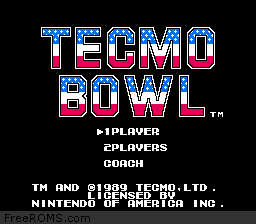

But tecmo bowl had the best GAMEPLAY! This game single-handedly kept the NES alive in many households even after Super NES and Nintendo 64 came out.
My point is GAMEPLAY = Content. Content is king > People looking for information want it to be delivered as simply and accessible as possible. People looking for solutions to problems want the solutions to be delivered as simply and accessibly as possible. For most businesses in Nigeria, even tech, your target market is not even online 
There are so many challenges to overcome in Nigeria in delivering a product, there is no room for assumptions. Many startups need to start using tech primarily as an internal tool reap operational efficiency and deliver solutions to clients in a way that requires minimal behavioral or current process adjustment.
The goals should be simplicity with minimal friction.
4 Likes
I don’t agree with the SNES analogy, Super Mario, Mortal Kombat, Donkey Kong, EA sports FIFA 94, Mario Kart, Battle Toads, Zelda, Kontra, ISS deluxe, Street Fighter, Killer Instinct e.t.c those are some of the main games that still makes people install SNES emulator on their smartphones.
I can’t even agree on the target market not been online bcos I spam blogs with affiliate links and I see different results…
Making money online requires the founder to have a huge fan base, or look for an established market or create a website/blog and build a large amount of followers… e.t.c
Great great article!
I’m such a big fans of these guys and how data driven their operation is. Some of the best entrepreneurs I have worked with in Nigeria. Period.
1 Like
Good piece!
Understand the Problem>Build MVP>>Build Userbase>>>Decide (To Stay ALIVE or DIE)
1 Like
Totally spot on! Stop obsessing about your product/offering and continue growing connections with people who need it. The more customers you have, the more successful your product will be. No matter how simple that sounds, many of us struggle to stay focused.
2 Likes
hehe… All I have been saying since 2014
Build only what you can sell, if they come, you build.
If you fail in marketing/user acq and doing that profitably… then you very well would fail in the product itself…cos no one would use what they can’t discover.
but it’s faster to realize that…and that makes less risky which increases your odds at success.
[ It’s times like this I feel I should pour out my brain… but I’ll rather just find links to some pieces I have written in the past cos ain’t nobody got time for that… just yet]
[1] https://twitter.com/tjwizking/status/562463196133748737?ref_src=twsrc^tfw
[2] http://mystartupnotes.blogspot.com/2015/02/this-is-one-singular-reason-why-8-out.html
hehe… How do you know there is a niche in the first place?
How do you know there is a market in the first place???
Oh… my point is speak to people by all means. You don’t need code to test software.
Code is needed to create a software which means code is needed to test what it created…
Alright…
Spot on Wezam! Nothing to add or subtract. I can totally relate to this part of the article --> “Figuring out a form of marketing that works is tough; you have to experiment, experiment and experiment till it (almost) drives you crazy” 
1 Like